Head Office & Works
SY. NO. 103/1, BESIDE JAIN INTERNATIONAL SCHOOL, KUCHARAM(V), TOOPRAN(M), MEDAK DIST.-502381.
Gantry cranes refer to the overhead crane, which is also supported by freestanding legs, which move on wheels or on fixed rails that are fixed on the floor. Gantry cranes are not supported by a building as opposed to the traditional bridge crane that runs on a high runway system connected to the building. This is the important aspect that enables them to be used in all the applications either indoor or outdoor because they do not need to have the available building support columns.
The simplest one is a horizontal beam (the bridge) which is extended between two legs creating a gantry or portal frame. This bridge has a hoist and trolley system that travels over the bridge and lifts, lowers, and carries heavy items across a specific square space.
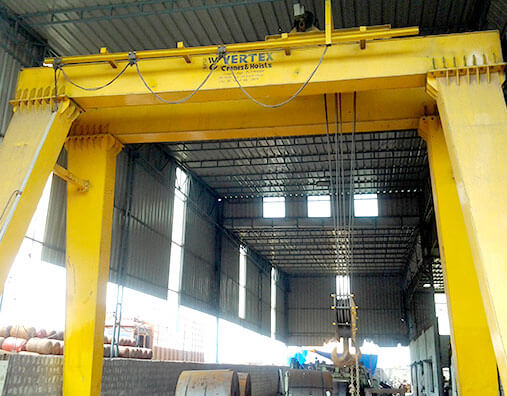
Gantry cranes vary in design and capacity to suit different operational needs.
Within the above types, the bridge can be a single beam or a double beam, depending on the scope of the application.
This three-axis rotation enables effective working with materials in a large working area with a minimum manual interference.
An EOT crane consists of a number of essential parts, which act in harmony with each other:
All components are made to support massive loads in a manner that is safe and easy to operate.
The independence from building structures grants gantry cranes a wide range of uses:
The manufacturing of gantry cranes is a precise engineering process focused on safety, durability, and performance.
A gantry crane is a lifting crane supported by legs that move on rails or wheels on the ground, while an EOT crane is mounted on runways attached to a building structure.
Common types include full gantry cranes, semi-gantry cranes, portable gantry cranes, and rubber-tyred gantry (RTG) cranes. Each type varies based on mobility, span, and load capacity.
Gantry cranes are widely used in shipyards, construction sites, warehouses, steel plants, and container yards. They are ideal for handling heavy loads in outdoor or large open spaces.
They are manufactured using high-strength structural steel, precision machining, and controlled welding processes. Quality standards typically include ISO, FEM, CMAA, and IS standards, along with load testing and safety inspections.