Head Office & Works
SY. NO. 103/1, BESIDE JAIN INTERNATIONAL SCHOOL, KUCHARAM(V), TOOPRAN(M), MEDAK DIST.-502381.
In industrial settings, particularly heavy lifting, selecting the appropriate crane system is paramount to both efficiency, safety, and long-term cost-saving. Portal cranes and gantry cranes are the two frequently used lifting solutions. Although these might look similar to one another, their structure, application, mobility and installation needs vary greatly. Knowledge of such differences will aid businesses in making the appropriate choice of the solutions to their operations based on them.
A portal crane is a crane that runs on rails at ground level and it is commonly employed in ports, shipyards and large outdoor premises. It is characterised by moving legs with one or two girders connected to the legs. Portal cranes are specifically designed to work with heavy loads like shipping containers, bulk items and ship parts.
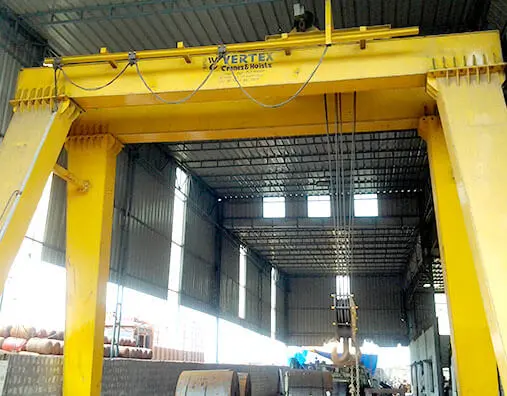
They are usually observed in big oceanic plants and container terminals that need intermittent and heavy lifting.
A gantry crane is a multi-purpose crane that is mounted on freestanding legs mounted on wheels or rails. It does not have a permanent connection with a building structure but operates over a working area. Gantry cranes may be placed either outside or inside and are common in warehouses, workshops, construction and manufacturing factories.
They have various designs such as full gantries, semi-gantry and portable designs, so that they can fit in the requirements of any industry.
The decision on whether to use a portal crane or a gantry crane depends on a number of factors:
In case your company acts in the area of a port or a shipyard which deals with heavy loads of cargo and has to handle hundreds of them every day, then a portal crane is probably the best choice. A gantry crane would however be smarter should you need a flexible, cost effective and versatile lifting system whether in industrial or construction purposes.
Portal cranes as well as gantry cranes are robust lifting solutions because they aim to enhance productivity and operational efficiency. The correct decision will be determined by your business needs. Having an assessment of your needs in running operations and long-term objectives will enable you to choose a crane system that will give maximum benefits in terms of safety, efficiency and ROI.
The primary difference lies in their structure and application. A portal crane is typically used in ports and shipyards, mounted on rails, and designed for handling heavy cargo containers. A gantry crane, on the other hand, has a bridge supported by legs that move on wheels or rails and is commonly used in factories, warehouses, and construction sites. Portal cranes are ideal for large-scale marine operations, while gantry cranes are more versatile for industrial settings.
Portal cranes are mainly used in ports, shipyards, and container terminals for loading and unloading cargo. Gantry cranes are widely used in manufacturing plants, precast yards, warehouses, rail yards, and construction projects where heavy materials need to be moved efficiently.
Your choice depends on load capacity requirements, operational environment, mobility needs, installation space, and budget. Portal cranes are better suited for heavy-duty outdoor port operations, while gantry cranes are more adaptable and cost-effective for general industrial and construction applications.
Gantry cranes offer flexibility, easier installation, lower infrastructure costs, and suitability for both indoor and outdoor use. They can be customized in size and capacity, making them a practical solution for businesses looking for efficient material handling without the extensive setup required for large portal cranes.