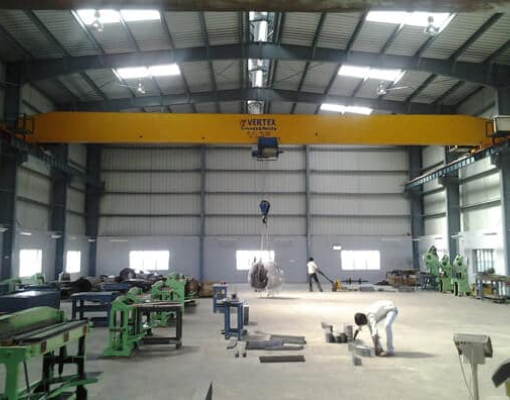
This three-axis rotation enables effective working with materials in a large working area with a minimum manual interference.
An EOT crane consists of a number of essential parts, which act in harmony with each other:
- Bridge Girders: This is the main horizontal structure, and could be either single or double girders.
- End Carriages: Take place on the ends of the bridge, with a travel of length.
- Hoist Unit: This contains the motor, the drum, the wire rope or the chain, and the hook.
- Runway Rails: These are attached to the columns or building structures.
- Electrical System: Controls motors, limit switches and safety devices.
- Control System: Pendant operation, radio remote or cabin operation.
All components are made to support massive loads in a manner that is safe and easy to operate.
TYPES OF EOT CRANES
EOT cranes are classified based on design and application requirements:
- Single-Girder EOT Cranes: The cranes operate on a single girder and are applicable in light to medium duty work, which is normally not more than 20 tonnes. They are less expensive and less demanding in terms of headroom.
- Double girder EOT Crane: These cranes have two main girders which are meant to be used in heavy duty operations and with increased lifting capacities. They are more stable, have greater hook lift and have extended spans.
- Underslung EOT Cranes: These cranes are mounted beneath the runway beam, and they are most suitable in cases where there is limited height of the building or cases where the loads need to be shifted between the bays.
KEY FEATURES OF EOT CRANES
EOT cranes are popular in industries because they have a number of features which are advanced:
- High Load Capacity: Has the ability to work with heavy and bulky materials.
- Precision Handling: Accurate load positioning due to smooth acceleration and braking.
- Sturdy Construction: Made to last long in harsh industrial environments.
- Adjustable Design: Span, capacity, duty class, and speed are all adjustable.
- Safety Systems: overload protection, limit switches, emergency stops, brakes.
BENEFITS OF USING EOT CRANES
- Improved Productivity: EOT cranes significantly reduce material-handling time, enabling faster workflow and improved production efficiency.
- Enhanced Workplace Safety: By minimising manual lifting, EOT cranes reduce the risk of injuries and accidents. Built-in safety mechanisms further enhance operational security.
- Optimal Space Utilisation: Since the crane operates overhead, floor space remains clear for other activities, improving overall plant layout.
- Cost-Effective Operation: Although the initial investment may be high, low maintenance costs, durability, and reduced labour requirements make EOT cranes economical in the long run.
- Versatility: EOT cranes can handle a wide variety of loads, including raw materials, semi-finished goods, and finished products, using different lifting attachments.
INDUSTRIAL APPLICATIONS OF EOT CRANES
EOT cranes are applied in a variety of industries because of their versatility and power:
- Manufacturing Plants: Moulds, machinery and components.
- Steel and Metal Industries: Relocation of billets, coils, plates and heavy buildings.
- Warehouses and Logistics: loading and unloading of heavy items.
- Power Plants: Repair of turbines, generators and transformers.
- Automobile Industry: Material flow and assembly line.
- Construction and Fabrication Yards: Building artificial buildings and machines.
Their ability to operate continuously makes them indispensable in high-demand environments.
CONCLUSION
The modern industrial material handling largely depends on EOT cranes. Their powerful structure, high productivity, and multiple use make them a safe and reliable solution to the problem of lifting and transportation of large items. Their features, benefits, and applications will be understood to assist industries to choose the appropriate crane system to improve their productivity, space management, and operational safety.
FAQ'S:
An EOT crane is an electrically powered overhead traveling crane that can move things side to side and up and down along a set runway beam.
The main features include a bridge girder, hoist, trolley, end carriages, and controls for precise load handling.
Key benefits are improved efficiency, increased safety, reduced manual labour, and high load capacity in industrial operations.
They are commonly used in manufacturing plants, steel mills, warehouses, shipyards, and heavy machinery workshops.