Head Office & Works
SY. NO. 103/1, BESIDE JAIN INTERNATIONAL SCHOOL, KUCHARAM(V), TOOPRAN(M), MEDAK DIST.-502381.
Jib cranes are used in manufacturing, construction, storage and maintenance. The simplicity, efficiency and localised lifting and placement makes these cranes more productive and safer in a wide variety of working conditions. This has been a detailed discussion of their specifications, use in general and in real life.
A jib crane is a type of overhead lifting device that features a horizontal beam (the jib or boom) supporting a movable hoist. This hoist lifts and positions load in a circle or semicircle along the jib. Jib cranes service specialised workstations and are smaller than bridge cranes, ensuring precise and flexible lifting.
The basic construction of a jib crane is a horizontal beam (jib or boom) that is attached to a vertical support which can be rotated. The lifting mechanism which is usually a hoist or chain block moves over the entire length of the jib. The main specifications to be taken into account are:
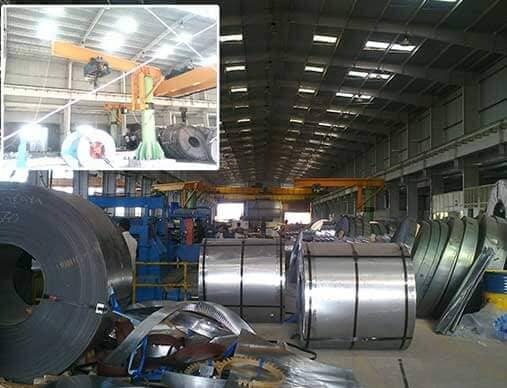
The jib crane excels in localised, repetitive material handling. Its primary function is to empower a single operator to move heavy, bulky, or delicate items quickly and safely within a defined space, reducing manual strain and increasing throughout.
The popularity of the jib crane stems from its clear advantages: cost-effectiveness, space efficiency, ease of installation, and operational simplicity requiring minimal training.
Their implementation is, however, characterised by a limitation: a strictly localised work envelope. They do not have to be used to transport loads within a big building. To achieve success, it is important to prepare the work cell, the mounting structure should be able to sustain the dynamic loads, and the appropriate mounting style, rotation, and capacity to be used in a particular task should be chosen.
To select a suitable jib crane:
The jib crane is a demonstration of specialised efficacy in material management. It enhances safety, productivity, and comfort in a broad business and industrial environment since it facilitates the development of circular work areas that are easy to install, maintain, and are cost-effective. Since it is going to keep transforming its shape and capacity it will turn out to be a highly significant instrument in the years to come, to move things where they belong and do so repeatedly.
Jib cranes raise and transport items in a fixed circular or semi-circular region using a horizontal arm and a hoist. It precisely positions cargo by rotating the jib arm as the hoist moves along it.
Standard jib cranes feature load capacities of 250 kg to 5 tons, rotation angles of 180° to 360°, and arm lengths of 2 to 10 meters. They can be wall- or floor-mounted and operated manually or electrically.
Factory, warehouse, workshop, and maintenance departments employ jib cranes. They are perfect for localized lifting and repetitive material handling.
Precision load handling with jib cranes improves workplace safety, productivity, and physical labour. Many assembly lines, loading and unloading operations, fabrication shops, and equipment maintenance use them.